Where the species is at home
Tinted green are the 3 countries where the species occurs according to the scientific literature.
Country list: Mammal Diversity Database.
 Wildpulse Map
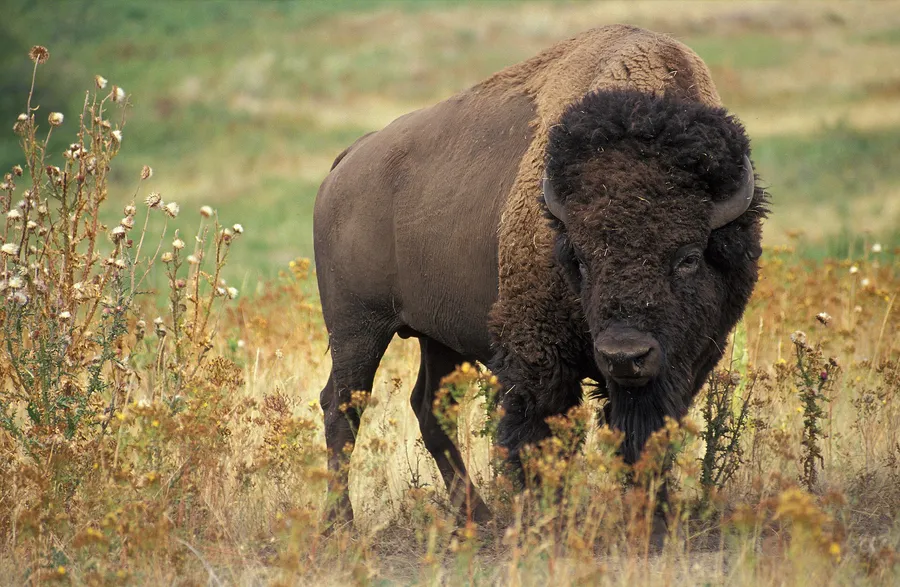
Bos bison
The American bison is a massive wild ox with a huge, low-slung head and a hump over the shoulders, and the largest land mammal in the Americas. It lives on the open grasslands of the continent, with the larger wood bison found farther north. Bison feed almost entirely on grasses and sedges. Tens of millions once roamed the plains, but hunting and slaughter in the 19th century left only a few hundred. Since 2016 the United States has officially honoured it as its national mammal.
In our data the species was reported on 1,288 days in 3 countries, most often in the USA, Canada and Mexico.
Last reported on November 19, 2026 in the USA (Colorado)
Photo: Jack Dykinga, Public domain
The area of each dot matches the weight.
Tinted green are the 3 countries where the species occurs according to the scientific literature.
Country list: Mammal Diversity Database.
Each hexagon is a cell about 40 km across in which people reported the species. The darker, the more days.
Where it stays pale, few reports come in. That does not mean the species is absent there. The latest reports pulse:
For each country, the place where the species was reported on the most days. Tap a place.
This is no promise. It shows where people report it especially often.
The species is most likely to be reported in January (58 % more often than the yearly average), least often in February (48 % less often). The bars show the difference from the yearly average, adjusted for the fact that more people are outdoors in summer. On the map, a cell is darker the more of its reports fall in the month shown.
January: 58 % more often than the yearly average.
Green means: in this month the species is reported there clearly more often than in the rest of the year. Blue means: clearly less often. We have adjusted for the fact that more people are outdoors in summer. Tap a square.
| J | F | M | A | M | J | J | A | S | O | N | D | |
|---|---|---|---|---|---|---|---|---|---|---|---|---|
| All countries | ||||||||||||
| USA | ||||||||||||
| Canada |
In the USA in September: reported 33 % more often than the yearly average. This is the strongest month there.
In how many of 10 areas of this species the other species was reported as well. Counted are the 45 cells in which this species is reported regularly; compared with the other species that have a page.
The map shows every cell with reports of this species, including the latest ones, and every other species as well.
View the American Bison on the map