Where it is reported
Most reports come from South America (100 %).
Counted are reporting days: days on which the species was reported at least once in a cell.
 Wildpulse Map
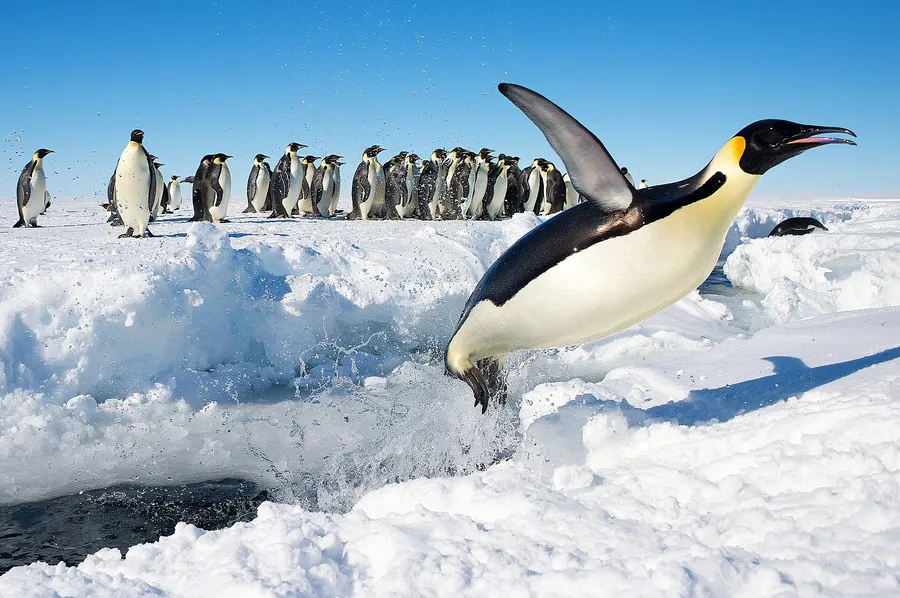
Aptenodytes forsteri
The emperor penguin is the largest of all penguins, with a black back, white belly and bright yellow ear patches. It lives only around Antarctica and hunts at sea for fish, krill and squid. It is the only penguin that breeds during the Antarctic winter, out on the ice. The female lays a single egg, which the male incubates on his feet for just over two months, eating nothing and losing a lot of weight.
In our data the species was reported on 1,001 days in 3 countries, most often in Antarctica, Argentina and Chile.
Last reported on November 4, 2026 in Antarctica (Antarctica)
Photo: Christopher Michel, CC BY 2.0
The area of each dot matches the weight.
Most reports come from South America (100 %).
Counted are reporting days: days on which the species was reported at least once in a cell.
Each hexagon is a cell about 40 km across in which people reported the species. The darker, the more days.
Where it stays pale, few reports come in. That does not mean the species is absent there. The latest reports pulse:
For each country, the place where the species was reported on the most days. Tap a place.
This is no promise. It shows where people report it especially often.
The species is most likely to be reported in November (38 % more often than the yearly average), least often in July (100 % less often). The bars show the difference from the yearly average, adjusted for the fact that more people are outdoors in summer. On the map, a cell is darker the more of its reports fall in the month shown.
January: 33 % more often than the yearly average.
Green means: in this month the species is reported there clearly more often than in the rest of the year. Blue means: clearly less often. We have adjusted for the fact that more people are outdoors in summer. Tap a square.
| J | F | M | A | M | J | J | A | S | O | N | D | |
|---|---|---|---|---|---|---|---|---|---|---|---|---|
| All countries | ||||||||||||
| Antarctica |
In Antarctica in October: reported 2.1 times as often as the yearly average. This is the strongest month there.
The map shows every cell with reports of this species, including the latest ones, and every other species as well.
View the Emperor Penguin on the map