Where it is reported
Most reports come from North America (69 %), from South America (15 %) and from Europe (10 %).
Counted are reporting days: days on which the species was reported at least once in a cell.
 Wildpulse Map
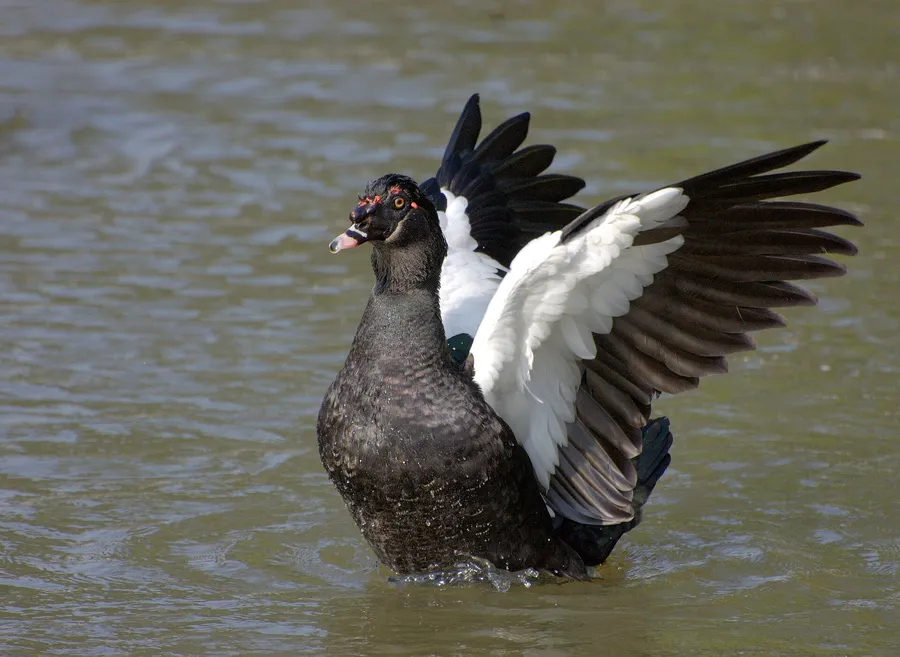
Cairina moschata
The Muscovy duck is a large duck, mostly black with big white wing patches, and males have bare dark red to blackish facial skin with a knobbly growth at the base of the bill. In the wild it lives in forested swamps, lakes and rivers from Mexico to Argentina and often roosts in trees at night. It feeds mainly on plants, grazing on land or dabbling in shallow water. Native Americans domesticated it long before Columbus, and feral populations of the domestic form now live in parts of Europe, the United States, Australia and New Zealand.
In our data the species was reported on 351,619 days in 144 countries, most often in the USA, Brazil and Spain.
Last reported on November 21, 2026 in the USA (Florida)
Photo: Dario Sanches from SÃO PAULO, BRASIL, CC BY-SA 2.0
The area of each dot matches the weight.
Most reports come from North America (69 %), from South America (15 %) and from Europe (10 %).
Counted are reporting days: days on which the species was reported at least once in a cell.
Each hexagon is a cell about 40 km across in which people reported the species. The darker, the more days.
Where it stays pale, few reports come in. That does not mean the species is absent there. The latest reports pulse:
For each country, the place where the species was reported on the most days. Tap a place.
This is no promise. It shows where people report it especially often.
The species is most likely to be reported in January (29 % more often than the yearly average), least often in June (24 % less often). The bars show the difference from the yearly average, adjusted for the fact that more people are outdoors in summer. On the map, a cell is darker the more of its reports fall in the month shown.
January: 29 % more often than the yearly average.
Green means: in this month the species is reported there clearly more often than in the rest of the year. Blue means: clearly less often. We have adjusted for the fact that more people are outdoors in summer. Tap a square.
| J | F | M | A | M | J | J | A | S | O | N | D | |
|---|---|---|---|---|---|---|---|---|---|---|---|---|
| All countries | ||||||||||||
| USA | ||||||||||||
| Brazil | ||||||||||||
| Spain | ||||||||||||
| Costa Rica | ||||||||||||
| Mexico | ||||||||||||
| Australia | ||||||||||||
| Portugal | ||||||||||||
| Colombia |
In the USA in January: reported 39 % more often than the yearly average. This is the strongest month there.
In how many of 10 areas of this species the other species was reported as well. Counted are the 4,641 cells in which this species is reported regularly; compared with the other species that have a page.
The map shows every cell with reports of this species, including the latest ones, and every other species as well.
View the Muscovy Duck on the map