Where it is reported
Most reports come from Asia (100 %).
Counted are reporting days: days on which the species was reported at least once in a cell.
 Wildpulse Map
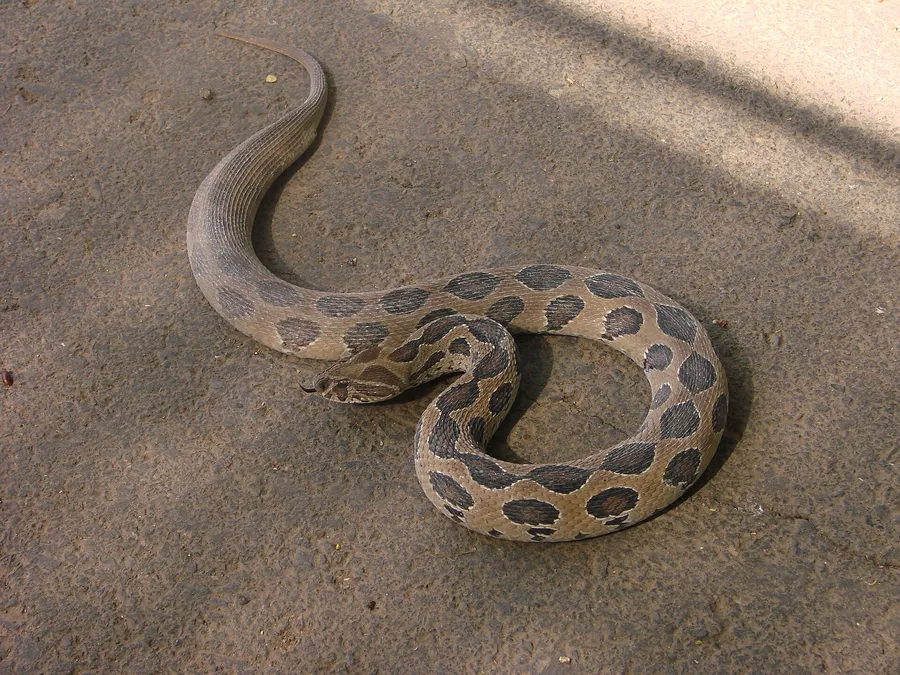
Daboia russelii
Russell's viper is a heavy-bodied venomous snake with three rows of dark, pale-edged blotches running down its yellowish to brown body. It lives across the Indian subcontinent in grassland, scrub and farmland, often near settlements, drawn by the rats and mice that live alongside people. When threatened it coils up and gives a very loud hiss. Its bite is extremely painful, and it is one of the 'Big Four', the snakes responsible for especially many serious bites in South Asia.
In our data the species was reported on 301 days in 2 countries, most often in India and Sri Lanka.
Last reported on November 21, 2026 in India (Maharashtra)
Photo: AChawla, CC BY-SA 3.0
The area of each dot matches the weight.
Most reports come from Asia (100 %).
Counted are reporting days: days on which the species was reported at least once in a cell.
Each hexagon is a cell about 40 km across in which people reported the species. The darker, the more days.
Where it stays pale, few reports come in. That does not mean the species is absent there. The latest reports pulse:
For each country, the place where the species was reported on the most days. Tap a place.
This is no promise. It shows where people report it especially often.
Across the year there is no clear difference between the months. The bars show the difference from the yearly average, adjusted for the fact that more people are outdoors in summer. On the map, a cell is darker the more of its reports fall in the month shown.
January: 36 % more often than the yearly average.
Green means: in this month the species is reported there clearly more often than in the rest of the year. Blue means: clearly less often. We have adjusted for the fact that more people are outdoors in summer. Tap a square.
| J | F | M | A | M | J | J | A | S | O | N | D | |
|---|---|---|---|---|---|---|---|---|---|---|---|---|
| All countries | ||||||||||||
| India |
In India in November: reported 58 % more often than the yearly average. This is the strongest month there.
The map shows every cell with reports of this species, including the latest ones, and every other species as well.
View the Russell's Viper on the map