Where it is reported
Most reports come from North America (100 %).
Counted are reporting days: days on which the species was reported at least once in a cell.
 Wildpulse Map
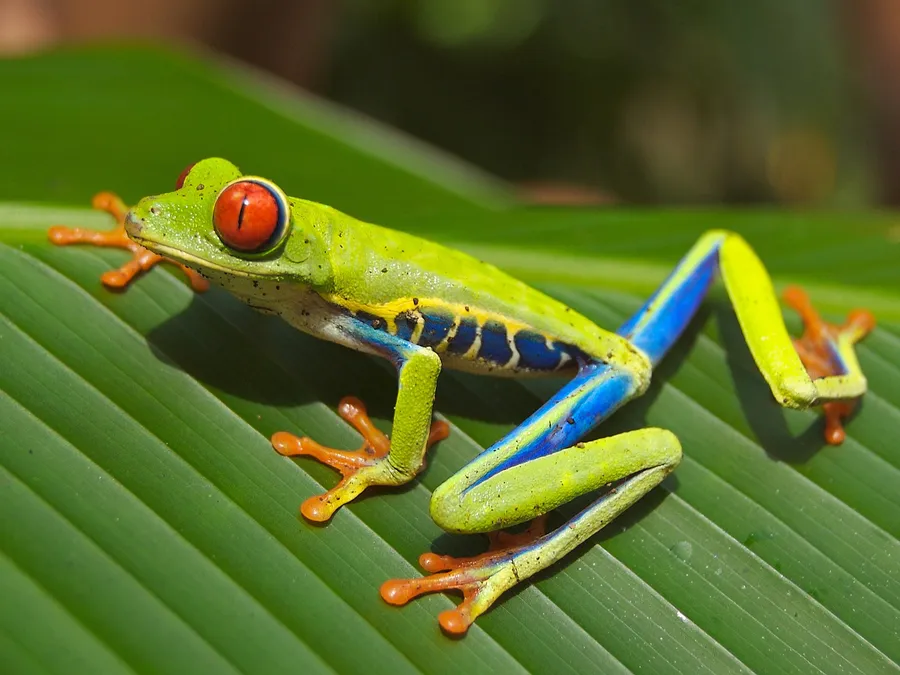
Agalychnis callidryas
The red-eyed tree frog is a slender, bright green tree frog with huge red eyes and blue flanks. It lives in the forests of Central America, from southern Mexico to Panama. At night it hunts insects such as moths, crickets and flies; by day it sleeps pressed against the underside of a leaf, hiding its bright colours. Females attach their eggs to leaves hanging over a pond, and the tadpoles drop straight into the water when they hatch, sometimes early if a predator shakes the clutch.
In our data the species was reported on 538 days in 4 countries, most often in Costa Rica, Panama and Nicaragua.
Last reported on November 3, 2026 in Costa Rica (Heredia)
Photo: Careyjamesbalboa (Carey James Balboa), Public domain
The area of each dot matches the weight.
Most reports come from North America (100 %).
Counted are reporting days: days on which the species was reported at least once in a cell.
Each hexagon is a cell about 40 km across in which people reported the species. The darker, the more days.
Where it stays pale, few reports come in. That does not mean the species is absent there. The latest reports pulse:
For each country, the place where the species was reported on the most days. Tap a place.
This is no promise. It shows where people report it especially often.
Across the year there is no clear difference between the months. The bars show the difference from the yearly average, adjusted for the fact that more people are outdoors in summer. On the map, a cell is darker the more of its reports fall in the month shown.
January: about as often as the yearly average.
Green means: in this month the species is reported there clearly more often than in the rest of the year. Blue means: clearly less often. We have adjusted for the fact that more people are outdoors in summer. Tap a square.
| J | F | M | A | M | J | J | A | S | O | N | D | |
|---|---|---|---|---|---|---|---|---|---|---|---|---|
| All countries | ||||||||||||
| Costa Rica | ||||||||||||
| Panama |
In Costa Rica in December: no clear difference from the yearly average. There are too few reports there to tell.
In how many of 10 areas of this species the other species was reported as well. Counted are the 22 cells in which this species is reported regularly; compared with the other species that have a page.
The map shows every cell with reports of this species, including the latest ones, and every other species as well.
View the American Red-eyed Tree Frog on the map