Where the species is at home
Tinted green are the 5 countries where the species occurs according to the scientific literature, paler the uncertain ones.
Country list: Mammal Diversity Database.
 Wildpulse Map
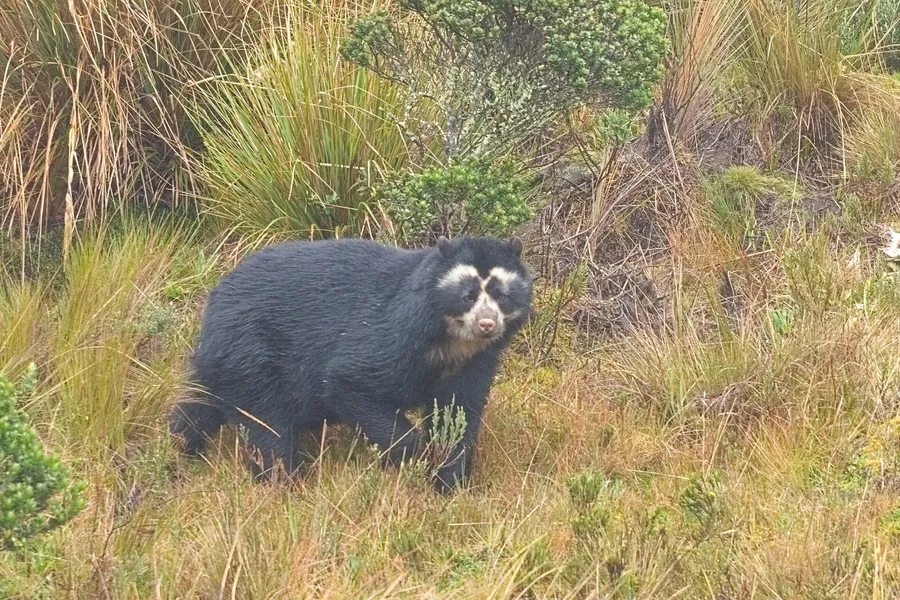
Tremarctos ornatus
The spectacled bear is a dark bear whose pale markings on the face and chest can look like a pair of glasses. No other bear is native to South America, and it is the last surviving short-faced bear. It lives in the Andes, from mountain forests to high grassland. Unlike most bears it is mainly a plant eater, feeding largely on bromeliads, cacti and fruit. It is an excellent climber, able to scale even the tallest Andean trees. The species is listed as vulnerable because of habitat loss.
In our data the species was reported on 887 days in 4 countries, most often in Ecuador, Colombia and Peru.
Last reported on November 16, 2026 in Colombia (Cundinamarca)
Photo: Attila Oláh, CC BY 4.0
The area of each dot matches the weight.
Tinted green are the 5 countries where the species occurs according to the scientific literature, paler the uncertain ones.
Country list: Mammal Diversity Database.
Each hexagon is a cell about 40 km across in which people reported the species. The darker, the more days.
Where it stays pale, few reports come in. That does not mean the species is absent there. The latest reports pulse:
For each country, the place where the species was reported on the most days. Tap a place.
This is no promise. It shows where people report it especially often.
Across the year there is no clear difference between the months. The bars show the difference from the yearly average, adjusted for the fact that more people are outdoors in summer. On the map, a cell is darker the more of its reports fall in the month shown.
January: 24 % more often than the yearly average.
Green means: in this month the species is reported there clearly more often than in the rest of the year. Blue means: clearly less often. We have adjusted for the fact that more people are outdoors in summer. Tap a square.
| J | F | M | A | M | J | J | A | S | O | N | D | |
|---|---|---|---|---|---|---|---|---|---|---|---|---|
| All countries | ||||||||||||
| Ecuador | ||||||||||||
| Colombia |
In Ecuador in May: no clear difference from the yearly average. There are too few reports there to tell.
In how many of 10 areas of this species the other species was reported as well. Counted are the 24 cells in which this species is reported regularly; compared with the other species that have a page.
The map shows every cell with reports of this species, including the latest ones, and every other species as well.
View the Andean Bear on the map