Where it is reported
Most reports come from Oceania (100 %).
Counted are reporting days: days on which the species was reported at least once in a cell.
 Wildpulse Map
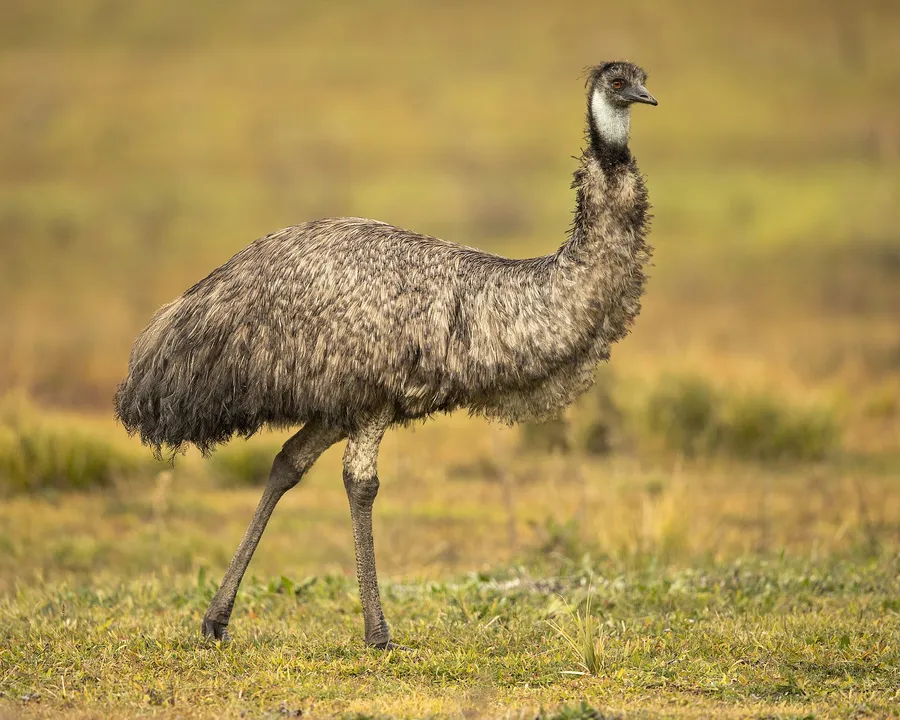
Dromaius novaehollandiae
The emu is a flightless bird with shaggy grey-brown plumage, a long neck and long, powerful legs; it is Australia's tallest native bird, and only the ostriches are taller. Found only in Australia, it lives in eucalyptus and savanna woodland and on heathland. An omnivore, it eats plants, fruit and insects, travels great distances to find food and can sprint at up to about 50 km/h. The female lays large green eggs, but it is the male who incubates them, barely eating or drinking for about eight weeks.
In our data the species was reported on 52,757 days in 11 countries, most often in Australia, New Zealand and Germany.
Last reported on November 14, 2026 in Australia (South Australia)
Photo: JJ Harrison, CC BY-SA 4.0
The area of each dot matches the weight.
Most reports come from Oceania (100 %).
Counted are reporting days: days on which the species was reported at least once in a cell.
Each hexagon is a cell about 40 km across in which people reported the species. The darker, the more days.
Where it stays pale, few reports come in. That does not mean the species is absent there. The latest reports pulse:
For each country, the place where the species was reported on the most days. Tap a place.
This is no promise. It shows where people report it especially often.
The species is most likely to be reported in September (30 % more often than the yearly average), least often in February (34 % less often). The bars show the difference from the yearly average, adjusted for the fact that more people are outdoors in summer. On the map, a cell is darker the more of its reports fall in the month shown.
January: 13 % less often than the yearly average.
Green means: in this month the species is reported there clearly more often than in the rest of the year. Blue means: clearly less often. We have adjusted for the fact that more people are outdoors in summer. Tap a square.
| J | F | M | A | M | J | J | A | S | O | N | D | |
|---|---|---|---|---|---|---|---|---|---|---|---|---|
| All countries | ||||||||||||
| Australia | ||||||||||||
| New Zealand |
In Australia in September: reported 26 % more often than the yearly average. This is the strongest month there.
In how many of 10 areas of this species the other species was reported as well. Counted are the 1,264 cells in which this species is reported regularly; compared with the other species that have a page.
The map shows every cell with reports of this species, including the latest ones, and every other species as well.
View the Emu on the map