Where the species is at home
Tinted green are the 61 countries where the species occurs according to the scientific literature, paler the uncertain ones.
Country list: Mammal Diversity Database.
 Wildpulse Map
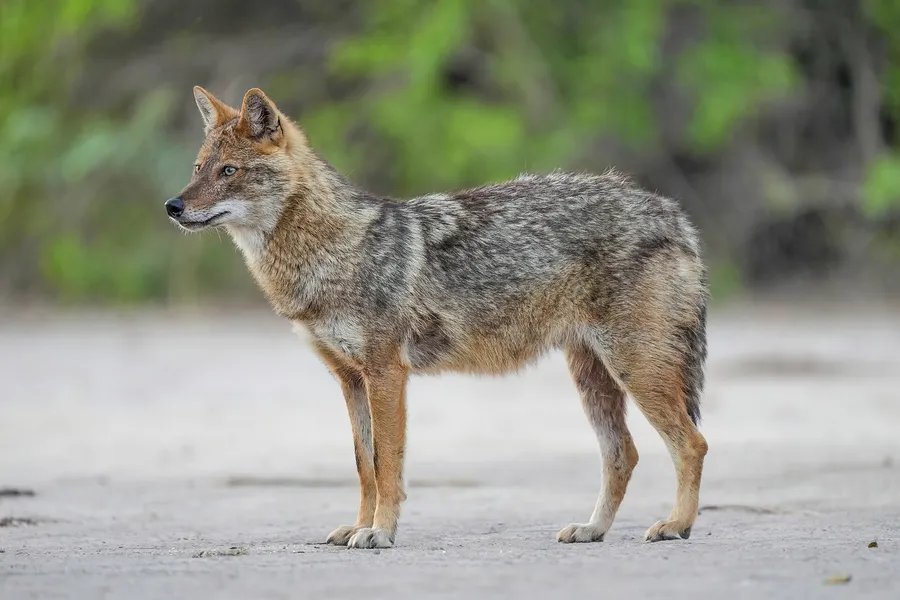
Canis aureus
The golden jackal is a wolf-like wild dog, closely related to the grey wolf, with a coat that is usually golden yellow. Native to Eurasia, it prefers open landscapes and ranges from southeastern Europe through the Middle East to South Asia; in Europe its core range is the Balkans. A highly adaptable feeder, it eats anything from fruit and insects to rodents, birds and small hoofed animals, and its basic social unit is a breeding pair with its young. In recent decades it has been spreading north and west across Europe.
In our data the species was reported on 906 days in 39 countries, most often in India, Romania and Norway.
Last reported on November 19, 2026 in India (Rajasthan)
Photo: Giles Laurent, CC BY-SA 4.0
The area of each dot matches the weight.
On average 3.0 km². The circle shows this area at the same scale as the city. Choose a city or tap the picture to move the circle.
Toronto is as big as 224 home ranges.
Toronto: 662 km². Home range: 3.0 km², as a circle 1.9 km across. One square in the grid is 10 km wide.
The species does not necessarily live in these cities; the comparison only shows the size. 3.0 km² is an average from the scientific literature (COMBINE). Real home ranges are not round and can be much smaller or larger depending on the region.
Tinted green are the 61 countries where the species occurs according to the scientific literature, paler the uncertain ones.
Country list: Mammal Diversity Database.
Each hexagon is a cell about 40 km across in which people reported the species. The darker, the more days.
Where it stays pale, few reports come in. That does not mean the species is absent there. The latest reports pulse:
For each country, the place where the species was reported on the most days. Tap a place.
This is no promise. It shows where people report it especially often.
The species is most likely to be reported in February (79 % more often than the yearly average), least often in July (44 % less often). The bars show the difference from the yearly average, adjusted for the fact that more people are outdoors in summer. On the map, a cell is darker the more of its reports fall in the month shown.
January: about as often as the yearly average.
Green means: in this month the species is reported there clearly more often than in the rest of the year. Blue means: clearly less often. We have adjusted for the fact that more people are outdoors in summer. Tap a square.
| J | F | M | A | M | J | J | A | S | O | N | D | |
|---|---|---|---|---|---|---|---|---|---|---|---|---|
| All countries | ||||||||||||
| India | ||||||||||||
| Romania | ||||||||||||
| Norway | ||||||||||||
| Serbia | ||||||||||||
| Greece | ||||||||||||
| Iran | ||||||||||||
| Switzerland | ||||||||||||
| Azerbaijan |
In India in February: no clear difference from the yearly average. There are too few reports there to tell.
In how many of 10 areas of this species the other species was reported as well. Counted are the 79 cells in which this species is reported regularly; compared with the other species that have a page.
The map shows every cell with reports of this species, including the latest ones, and every other species as well.
View the Golden Jackal on the map