Where it is reported
Most reports come from Africa (100 %).
Counted are reporting days: days on which the species was reported at least once in a cell.
 Wildpulse Map
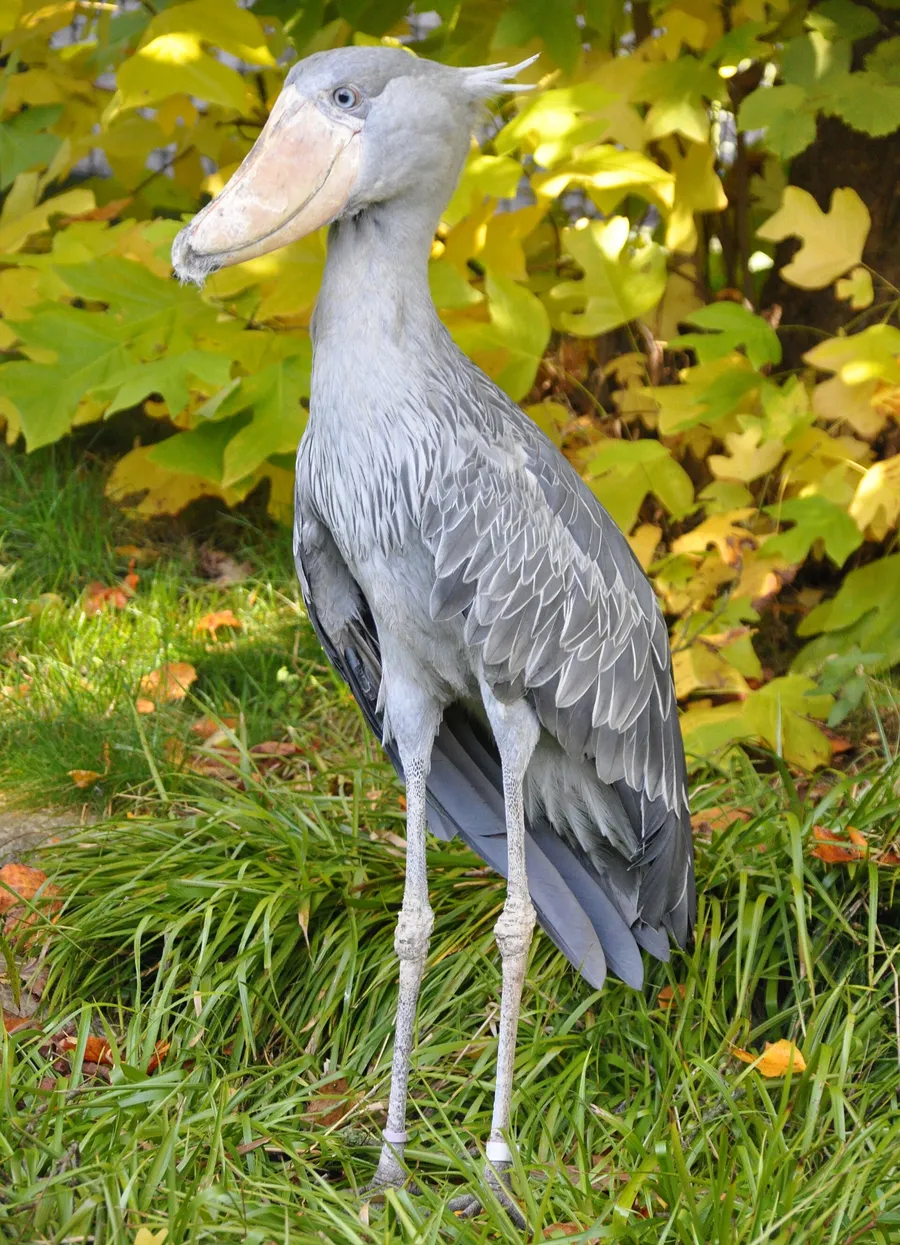
Balaeniceps rex
The shoebill is a huge blue-grey bird of Africa, named after its massive, shoe-shaped bill with a hooked tip. It lives in large swamps of tropical East Africa thick with papyrus and reeds, from South Sudan down to Zambia. It feeds mainly on fish, especially lungfish, as well as frogs, lizards and snakes. It often stands motionless for long periods before lunging at prey, and at the nest it communicates by loudly clattering its bill.
In our data the species was reported on 1,653 days in 6 countries, most often in Uganda, Zambia and the DR Congo.
Last reported on August 9, 2026 in Uganda (Mityana)
Photo: Quartl, CC BY-SA 3.0
The area of each dot matches the weight.
Most reports come from Africa (100 %).
Counted are reporting days: days on which the species was reported at least once in a cell.
Each hexagon is a cell about 40 km across in which people reported the species. The darker, the more days.
Where it stays pale, few reports come in. That does not mean the species is absent there. The latest reports pulse:
For each country, the place where the species was reported on the most days. Tap a place.
This is no promise. It shows where people report it especially often.
Across the year there is no clear difference between the months. The bars show the difference from the yearly average, adjusted for the fact that more people are outdoors in summer. On the map, a cell is darker the more of its reports fall in the month shown.
January: about as often as the yearly average.
Green means: in this month the species is reported there clearly more often than in the rest of the year. Blue means: clearly less often. We have adjusted for the fact that more people are outdoors in summer. Tap a square.
| J | F | M | A | M | J | J | A | S | O | N | D | |
|---|---|---|---|---|---|---|---|---|---|---|---|---|
| All countries | ||||||||||||
| Uganda | ||||||||||||
| Zambia |
In Uganda in July: no clear difference from the yearly average. There are too few reports there to tell.
In how many of 10 areas of this species the other species was reported as well. Counted are the 27 cells in which this species is reported regularly; compared with the other species that have a page.
The map shows every cell with reports of this species, including the latest ones, and every other species as well.
View the Shoebill on the map