Where it is reported
Most reports come from Europe (84 %) and from North America (15 %).
Counted are reporting days: days on which the species was reported at least once in a cell.
 Wildpulse Map
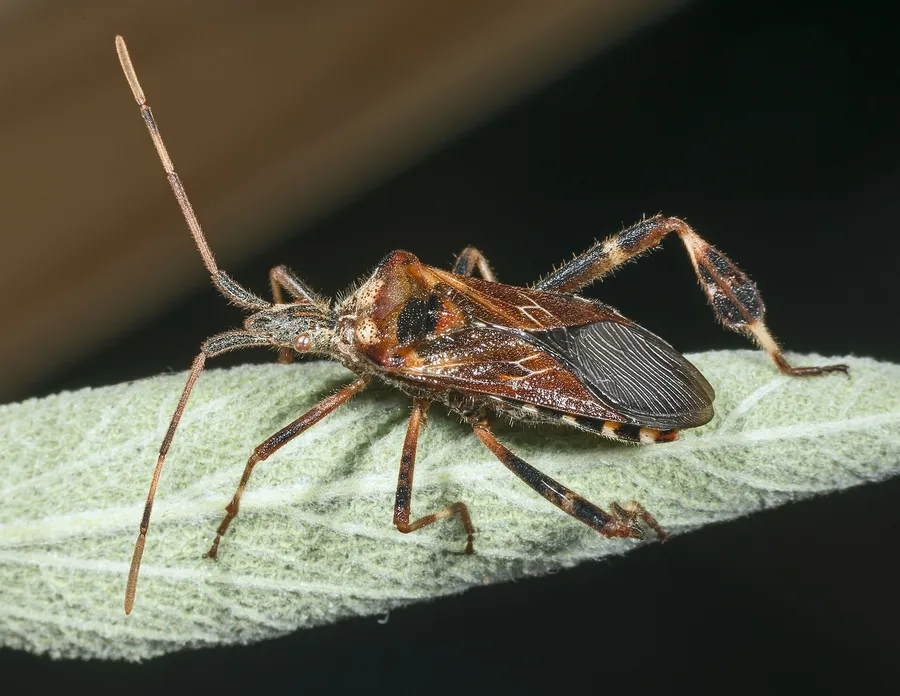
Leptoglossus occidentalis
The western conifer seed bug is a brown leaf-footed bug almost 2 cm long, named for the flattened, leaf-like widening on its hind legs. Native to western North America, it has spread across the east of the continent and, since 1999, through much of Europe. It sucks sap from developing conifer cones, which makes the seeds wither, a problem in seed orchards. In autumn it often becomes a nuisance by entering houses in search of a place to spend the winter, and when disturbed it releases an unpleasant smell.
In our data the species was reported on 21,948 days in 48 countries, most often in Germany, the United Kingdom and France.
Last reported on November 21, 2026 in Switzerland (Aargau)
Photo: Didier Descouens, CC BY-SA 4.0
The area of each dot matches the weight.
Most reports come from Europe (84 %) and from North America (15 %).
Counted are reporting days: days on which the species was reported at least once in a cell.
Each hexagon is a cell about 40 km across in which people reported the species. The darker, the more days.
Where it stays pale, few reports come in. That does not mean the species is absent there. The latest reports pulse:
For each country, the place where the species was reported on the most days. Tap a place.
This is no promise. It shows where people report it especially often.
The species is most likely to be reported in October (348 % more often than the yearly average), least often in June (89 % less often). The bars show the difference from the yearly average, adjusted for the fact that more people are outdoors in summer. On the map, a cell is darker the more of its reports fall in the month shown.
January: 2.5 times as often as the yearly average.
Green means: in this month the species is reported there clearly more often than in the rest of the year. Blue means: clearly less often. We have adjusted for the fact that more people are outdoors in summer. Tap a square.
| J | F | M | A | M | J | J | A | S | O | N | D | |
|---|---|---|---|---|---|---|---|---|---|---|---|---|
| All countries | ||||||||||||
| Germany | ||||||||||||
| United Kingdom | ||||||||||||
| France | ||||||||||||
| USA | ||||||||||||
| Belgium | ||||||||||||
| Denmark | ||||||||||||
| Canada | ||||||||||||
| Sweden |
In Germany in October: reported 4.2 times as often as the yearly average. This is the strongest month there.
In how many of 10 areas of this species the other species was reported as well. Counted are the 1,134 cells in which this species is reported regularly; compared with the other species that have a page.
The map shows every cell with reports of this species, including the latest ones, and every other species as well.
View the Western Conifer Seed Bug on the map