Where it is reported
Most reports come from North America (100 %).
Counted are reporting days: days on which the species was reported at least once in a cell.
 Wildpulse Map
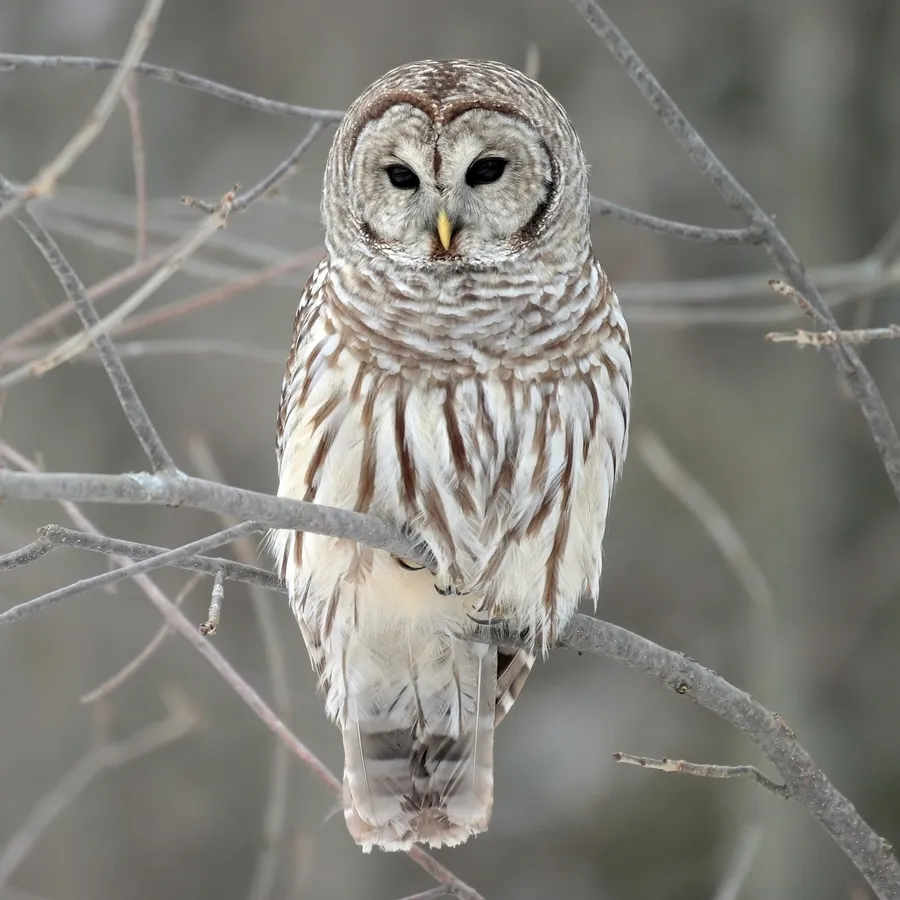
Strix varia
The barred owl is a grey-brown North American owl about half a metre long, with a round head, no ear tufts, dark brown eyes and a barred upper breast. It lives mainly in mature forests, often near water or swampy ground. It hunts chiefly small mammals but also catches birds, amphibians, reptiles and invertebrates. English speakers remember its call with the phrase "Who cooks for you?"; because it has spread west and is displacing the threatened spotted owl there, barred owls are being shot in parts of the West.
In our data the species was reported on 710,772 days in 3 countries, most often in the USA, Canada and Mexico.
Last reported on November 21, 2026 in the USA (Massachusetts)
Photo: Arad, CC BY-SA 3.0
The area of each dot matches the weight.
Most reports come from North America (100 %).
Counted are reporting days: days on which the species was reported at least once in a cell.
Each hexagon is a cell about 40 km across in which people reported the species. The darker, the more days.
Where it stays pale, few reports come in. That does not mean the species is absent there. The latest reports pulse:
For each country, the place where the species was reported on the most days. Tap a place.
This is no promise. It shows where people report it especially often.
The species is most likely to be reported in May (49 % more often than the yearly average), least often in November (31 % less often). The bars show the difference from the yearly average, adjusted for the fact that more people are outdoors in summer. On the map, a cell is darker the more of its reports fall in the month shown.
January: 18 % less often than the yearly average.
Green means: in this month the species is reported there clearly more often than in the rest of the year. Blue means: clearly less often. We have adjusted for the fact that more people are outdoors in summer. Tap a square.
| J | F | M | A | M | J | J | A | S | O | N | D | |
|---|---|---|---|---|---|---|---|---|---|---|---|---|
| All countries | ||||||||||||
| USA | ||||||||||||
| Canada |
In the USA in May: reported 50 % more often than the yearly average. This is the strongest month there.
In how many of 10 areas of this species the other species was reported as well. Counted are the 3,133 cells in which this species is reported regularly; compared with the other species that have a page.
The map shows every cell with reports of this species, including the latest ones, and every other species as well.
View the Barred Owl on the map