Where it is reported
Most reports come from Europe (96 %) and from Asia (4 %).
Counted are reporting days: days on which the species was reported at least once in a cell.
 Wildpulse Map
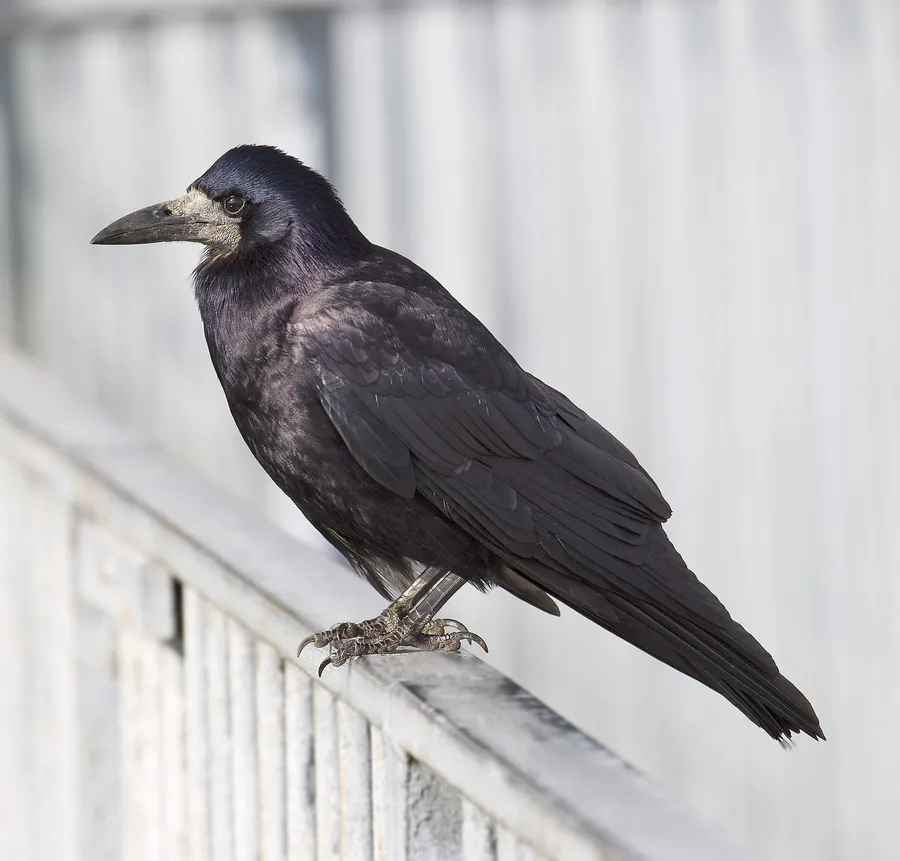
Corvus frugilegus
The rook is a glossy black crow; adults are easy to tell apart by the bare, greyish-white skin at the base of the bill. It ranges from Ireland and western Europe east to the steppes of Central Asia, living in open farmland and nesting in colonies that can be very large, often in town parks. It probes the soil with its pointed bill for earthworms, insect larvae and slugs, and also eats grain. Experiments with captive rooks have shown that they can use tools.
In our data the species was reported on 693,885 days in 75 countries, most often in the United Kingdom, Sweden and France.
Last reported on November 22, 2026 in Ukraine (Kyiv)
Photo: Andreas Trepte, CC BY-SA 2.5
The area of each dot matches the weight.
Most reports come from Europe (96 %) and from Asia (4 %).
Counted are reporting days: days on which the species was reported at least once in a cell.
Each hexagon is a cell about 40 km across in which people reported the species. The darker, the more days.
Where it stays pale, few reports come in. That does not mean the species is absent there. The latest reports pulse:
For each country, the place where the species was reported on the most days. Tap a place.
This is no promise. It shows where people report it especially often.
The species is most likely to be reported in January (25 % more often than the yearly average), least often in July (41 % less often). The bars show the difference from the yearly average, adjusted for the fact that more people are outdoors in summer. On the map, a cell is darker the more of its reports fall in the month shown.
January: 25 % more often than the yearly average.
Green means: in this month the species is reported there clearly more often than in the rest of the year. Blue means: clearly less often. We have adjusted for the fact that more people are outdoors in summer. Tap a square.
| J | F | M | A | M | J | J | A | S | O | N | D | |
|---|---|---|---|---|---|---|---|---|---|---|---|---|
| All countries | ||||||||||||
| United Kingdom | ||||||||||||
| Sweden | ||||||||||||
| France | ||||||||||||
| Germany | ||||||||||||
| Ireland | ||||||||||||
| Norway | ||||||||||||
| Poland | ||||||||||||
| Belgium |
In the United Kingdom in April: reported 17 % more often than the yearly average. This is the strongest month there.
In how many of 10 areas of this species the other species was reported as well. Counted are the 3,890 cells in which this species is reported regularly; compared with the other species that have a page.
The map shows every cell with reports of this species, including the latest ones, and every other species as well.
View the Rook on the map