Where it is reported
Most reports come from North America (100 %).
Counted are reporting days: days on which the species was reported at least once in a cell.
 Wildpulse Map
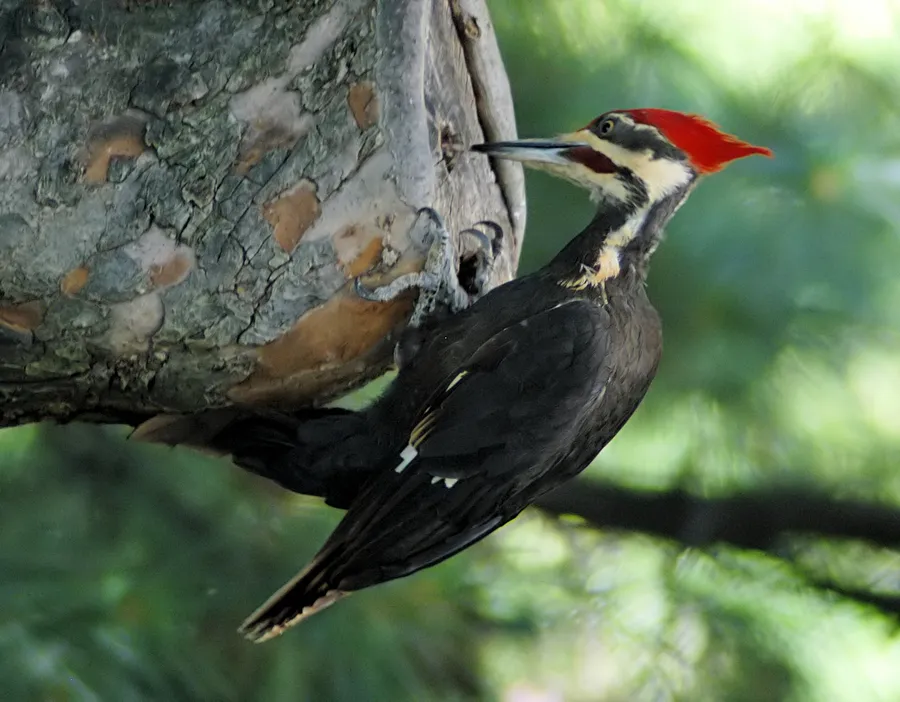
Dryocopus pileatus
The pileated woodpecker is a crow-sized, mostly black woodpecker with white face stripes and a flaming red crest. With the imperial and ivory-billed woodpeckers probably extinct, it is the largest woodpecker in North America confirmed to survive, living in deciduous and coniferous forests. Carpenter ants and wood-boring beetle larvae are its main food, and to reach them it chisels big, roughly rectangular holes into tree trunks. Its abandoned cavities later shelter many other birds and mammals.
In our data the species was reported on 2,164,016 days in 2 countries, most often in the USA and Canada.
Last reported on November 21, 2026 in the USA (New Jersey)
Photo: G. Edward Johnson, Lorax at English Wikipedia, CC BY-SA 3.0
The area of each dot matches the weight.
Most reports come from North America (100 %).
Counted are reporting days: days on which the species was reported at least once in a cell.
Each hexagon is a cell about 40 km across in which people reported the species. The darker, the more days.
Where it stays pale, few reports come in. That does not mean the species is absent there. The latest reports pulse:
For each country, the place where the species was reported on the most days. Tap a place.
This is no promise. It shows where people report it especially often.
The species is most likely to be reported in May (24 % more often than the yearly average), least often in July (28 % less often). The bars show the difference from the yearly average, adjusted for the fact that more people are outdoors in summer. On the map, a cell is darker the more of its reports fall in the month shown.
January: about as often as the yearly average.
Green means: in this month the species is reported there clearly more often than in the rest of the year. Blue means: clearly less often. We have adjusted for the fact that more people are outdoors in summer. Tap a square.
| J | F | M | A | M | J | J | A | S | O | N | D | |
|---|---|---|---|---|---|---|---|---|---|---|---|---|
| All countries | ||||||||||||
| USA | ||||||||||||
| Canada |
In the USA in May: reported 24 % more often than the yearly average. This is the strongest month there.
In how many of 10 areas of this species the other species was reported as well. Counted are the 3,768 cells in which this species is reported regularly; compared with the other species that have a page.
The map shows every cell with reports of this species, including the latest ones, and every other species as well.
View the Pileated Woodpecker on the map